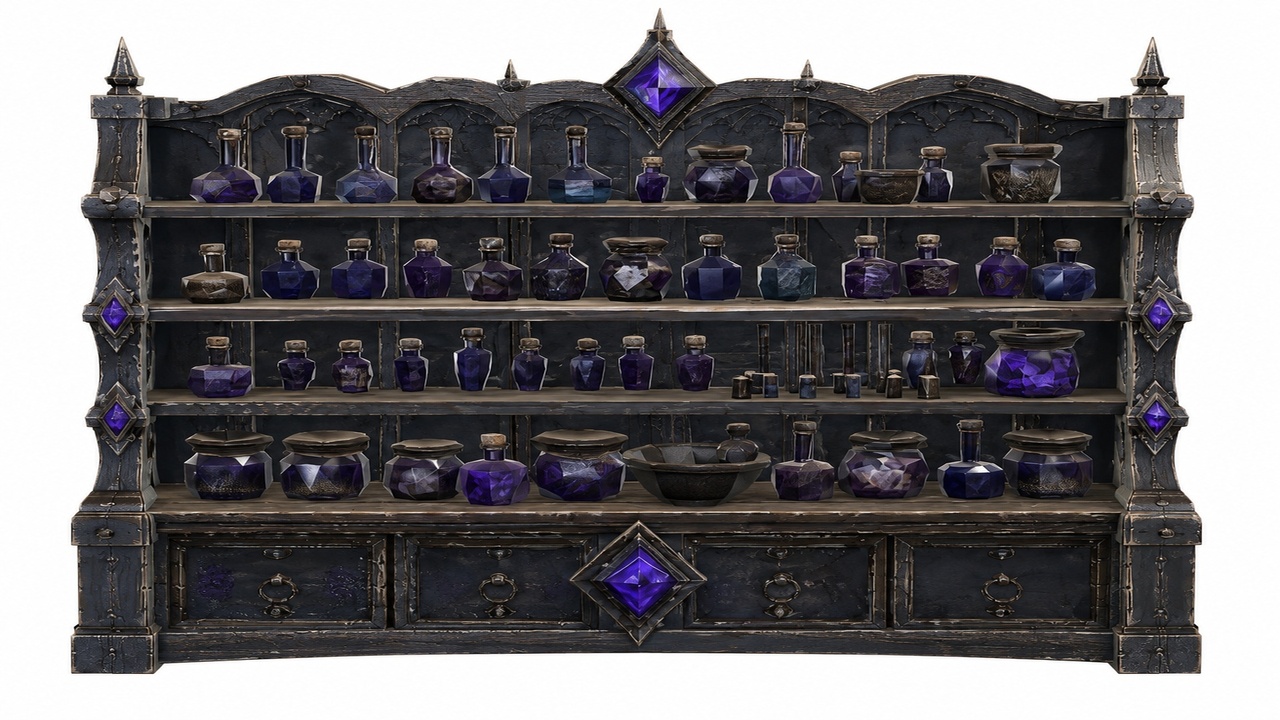
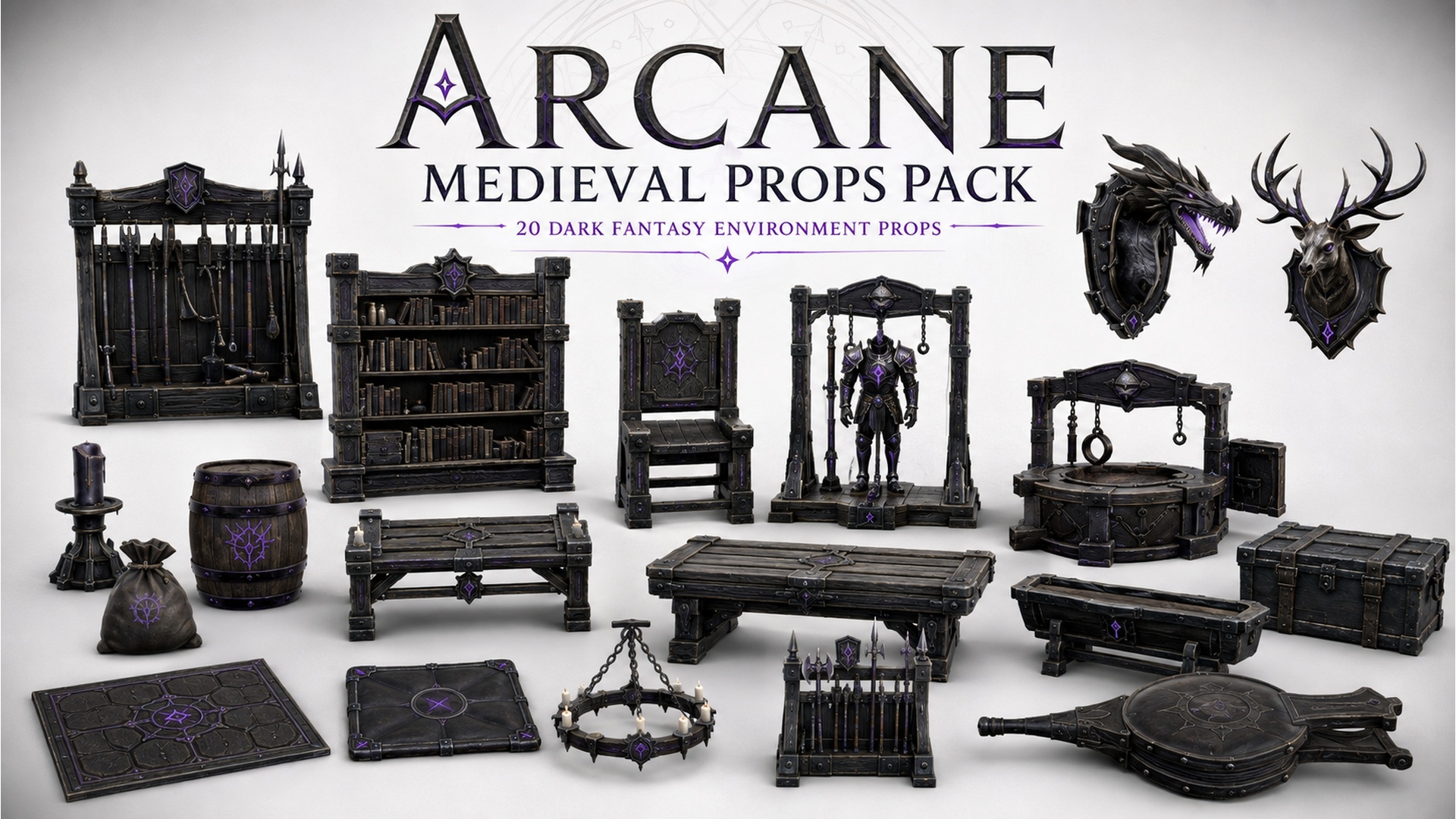
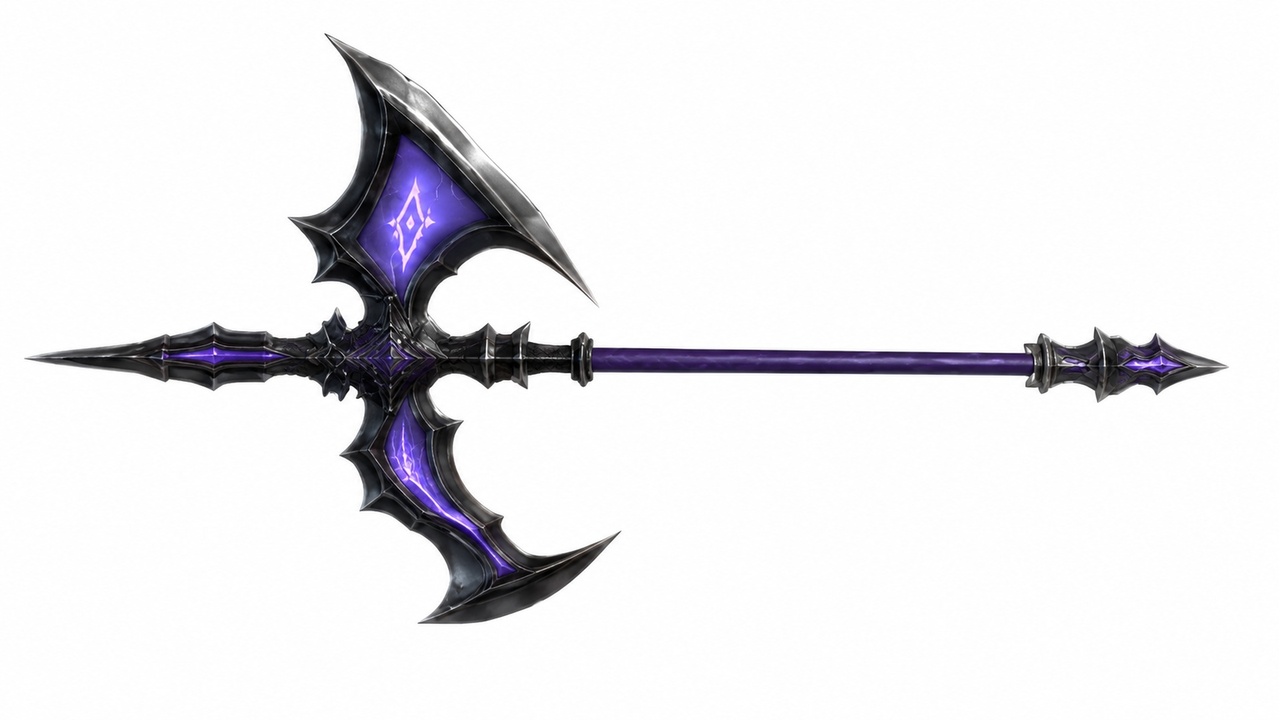
If the visual direction already fits, a themed pack is usually a faster starting point than collecting unrelated single props. Current starting points: Alchemy Pack — $20.99 · Arcane Props Pack — $34.99 · Custom prop — from $29.
Buying or downloading a good-looking 3D model is easy. Building a full game environment from assets that actually work together is much harder.
The fastest way to waste production time is to choose props one by one, discover later that the proportions or visual language do not match, and then spend hours fixing a scene that was supposed to save time.
A better approach is to judge assets as part of a system: what role they fill, how they read together, and how much integration work they create after import.
Start with the scene role, not the asset name
Before searching for a chest, sword, forge or bookshelf, define the scene you are trying to communicate.
For example, a fantasy blacksmith workshop may need several functional groups:
- a primary workstation,
- tool storage,
- material storage,
- equipment display,
- lighting,
- smaller storytelling props.
A ritual room has a different hierarchy. It may need a strong central object, seating or display furniture, candles, floor details and a few magical accents.
When each asset has a clear role, it becomes much easier to reject objects that are attractive but unnecessary.
Choose one visual language first
A scene can contain individually high-quality models and still look inconsistent.
The usual problem is not polygon count. It is visual language.
Look for agreement in:
- shape language,
- material treatment,
- level of surface detail,
- edge softness or sharpness,
- color intensity,
- fantasy exaggeration,
- ornament density,
- overall proportions.
If one weapon is highly realistic, another is heavily stylized and the furniture uses exaggerated low-poly proportions, the player notices the mismatch even if every object is well made.
This is why a coherent themed collection can be more useful than a larger pile of unrelated assets.
Build with hero assets and support assets
Not every model should demand attention.
Pick a few hero assets that define the location from a distance. These can be a forge, throne, large rack, ritual floor piece, major workstation or distinctive weapon display.
Then use support assets around them: storage, smaller tools, candles, sacks, barrels, shelves and other secondary props.
This hierarchy helps the environment remain readable and usually makes the asset list smaller.
A useful test is to temporarily hide all small objects. If the room no longer communicates its purpose, the large-form structure is probably too weak.
Check proportions before you commit to the whole set
A beautiful asset can still become expensive if its scale feels wrong next to your player or environment.
Before building a full room, test a small group in engine:
- one large object,
- one medium prop,
- one small prop,
- one character or known scale reference.
Check door-height relationships, working-height relationships, hand-sized items and walking clearance.
You are not only checking numeric scale. You are checking whether the proportions feel believable from the actual gameplay camera.
Separate modular construction from ordinary props
Modular environment pieces and decorative props solve different problems.
Modular pieces need predictable relationships so they can be reused to construct larger spaces. Ordinary props mainly need to sit convincingly inside those spaces.
Do not assume every prop needs to snap to a grid. A wall section and a decorative bottle have completely different placement requirements.
For production planning, it helps to divide your asset list into:
- structural pieces,
- functional environment props,
- equipment,
- decorative storytelling props,
- natural environment assets.
That makes missing categories obvious before the level becomes cluttered.
Inspect the real listing, not only the preview image
Marketplace thumbnails are designed to show an asset at its best. Your game needs technical information as well.
Before committing to an asset, check the current marketplace listing for the details that matter to your project, such as available file formats, engine support, texture information, geometry details, included variations and license terms.
Do not assume that two visually similar assets have identical technical preparation.
For Knit of Shadows assets, the current catalog is organized by theme, while final availability, pricing, license details and technical information are confirmed on each Fab listing.
Prefer reusable props when the world has more than one room
A useful environment prop should often work in several contexts.
A chest can appear in a workshop, storage room, guild hall or dungeon. A bookshelf can support a study, ritual room or living space. A weapon rack can appear in a forge, guard room or armory.
This kind of reuse gives you more value than an object that only works in one exact camera composition.
The goal is not to make every asset generic. The goal is to build a vocabulary that can repeat without making every location feel identical.
Match asset density to gameplay distance
Players rarely inspect every model from a portfolio camera angle.
Third-person, survival and action games often need silhouettes and material separation that remain readable at gameplay distance. Tiny surface detail may disappear while large proportions and clear shapes remain visible.
When choosing between two assets, ask which one communicates its purpose faster from the player's normal camera.
That question is often more useful than asking which model has more detail.
Do a small integration test before buying or building around a full family
The cheapest time to discover a mismatch is before the whole scene depends on it.
Test a small group under your actual:
- camera,
- lighting,
- environment scale,
- material setup,
- performance target.
If the set still feels coherent there, expanding it is much safer.
If it does not, you have only tested a few objects instead of rebuilding an entire environment.
Use themed collections when consistency matters more than maximum variety
When the scene needs a strong shared identity, start from one coherent family and add outside assets only when there is a clear gap.
The Knit of Shadows catalog currently groups related work into focused collections, including Arcane Medieval Props, Weapons & Equipment and other fantasy environment categories.
That makes it easier to start with a consistent base instead of discovering compatibility problems after the room is already assembled.
If you want to inspect a live Fab listing rather than only browse the site collection, three current starting points cover different scopes:
- Arcane Medieval Props Pack — a broader environment/prop family.
- Void Knight Arsenal — a larger weapon/equipment collection.
- Void Knight Arcane Archery Set — a smaller focused equipment set.
These links point to the current marketplace listings so the buyer can verify the live price, license and technical details there before purchase.
When a custom asset is cheaper than forcing the wrong one
Sometimes the missing piece is very specific: a workstation with a particular silhouette, a matching storage prop, a weapon display, or one object that needs to fit an established themed set.
At that point, modifying the entire environment around a nearly-correct marketplace asset may cost more production time than requesting a focused custom model.
If the gap is small and concrete, review the current Custom 3D scope and compare that route with the cost of reworking the scene.
Final checklist
Before committing to a fantasy asset family, ask:
- Does the asset fill a real scene role?
- Does it share the same visual language as the rest of the environment?
- Are hero and support assets balanced?
- Do the proportions work from the gameplay camera?
- Am I separating structural pieces from ordinary props?
- Have I checked the real marketplace listing for technical details?
- Can important props be reused elsewhere in the game?
- Does the asset remain readable at normal gameplay distance?
- Have I tested a small group in the actual engine scene first?
A marketplace asset should save production time, not move the work somewhere else.
The best set is not necessarily the biggest one. It is the one that lets you build a coherent environment quickly, keeps iteration predictable, and leaves you with fewer compatibility problems later.
These current Fab listings fit the production topic discussed above.
Fantasy Dungeon Stalactite Ceiling — $4.99 →
Fantasy Ancient Worn Satchel — $4.99 →
Fantasy Gothic Arcane War Banner — $4.99 →
If the catalog is missing a specific piece, review the custom 3D scope and send a focused request.
Request a custom asset →