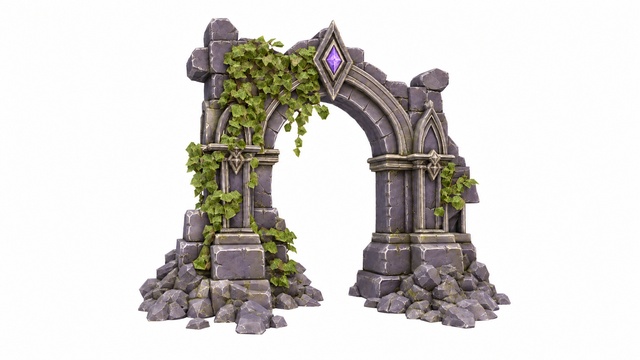
Arcane buildings do not always need a hundred-piece modular kit. If the base structure already exists, a few strong gothic 3D building components can extend a fantasy environment, replace weak placeholders and establish a consistent visual language without rebuilding the whole scene.
Want to inspect the style before buying architecture pieces? Start with the Fantasy Arcane Gothic Crystal Chapel — a complete free 3D building sample. It is the fastest way to judge the stone, gothic silhouette and violet-crystal direction in context before browsing paid building assets.
For a Unity-style real-time environment, the most useful pieces are usually the ones that change how the player reads or moves through the space: walls and openings, stairs, doors, structural supports and a distinctive floor element. Knit of Shadows currently has five separate Fab listings that cover exactly those roles:
- Fantasy Arcane Gothic Window Wall
- Fantasy Arcane Gothic Staircase
- Fantasy Arcane Gothic Door
- Fantasy Arcane Gothic Pillar
- Fantasy Arcane Ritual Floor Tile
These are separate current listings, not a finished full modular building kit. Final pricing, technical information and availability are always confirmed on each Fab listing.
Fast buying path for an arcane building
If the goal is to test the style with the smallest spend, use this order instead of buying a large kit first:
- Free: inspect the complete Fantasy Arcane Gothic Crystal Chapel.
- Single architecture piece: current Window Wall, Staircase, Door, Pillar and Ritual Floor Tile listings are each shown at $4.99 in the current Fab catalog snapshot.
- Broader scene: move to the Fantasy Gothic Building 3D Assets page only if the visual direction already fits.
- Exact missing part: if the catalog does not contain the needed piece, use the custom 3D prop request rather than buying unrelated assets.
This creates a simple free sample → $4.99 component → larger catalog → custom missing piece path. Fab remains the source of truth for live price and license terms.
If you are shopping rather than planning, the Fantasy Gothic Building 3D Assets page groups the matching architecture listings in one place. This guide stays focused on how the parts should work together, so the site does not create duplicate pages for the same search intent.
Quick role map for a medieval building 3D blockout
| Component | What it solves | What to check in-engine |
|---|---|---|
| Window wall | facade rhythm, openings, room readability | scale, wall thickness, opening height |
| Staircase | vertical circulation | rise/run, landing height, player clearance |
| Door | transition between spaces | doorway width, pivot, swing/placement clearance |
| Pillar | structural rhythm and corners | spacing, repetition, roof/balcony alignment |
| Ritual floor tile | focal ground plane | tile boundaries, repetition, walkable surface |
This is enough to test a small stylized or low-poly medieval house, workshop, tower room or ritual chamber before committing to a full architecture pack. It is not enough to claim a complete modular building system: a full kit also needs corners, roof coverage, floor coverage, opening variants and reliable transitions between modules.
What makes an arcane building read clearly in a game scene?
The architecture should communicate the building's purpose before small decoration is added. A useful order is:
- establish the wall/opening rhythm;
- make entrances and vertical circulation obvious;
- repeat one structural language with pillars or supports;
- use the floor to mark important gameplay or ritual space;
- add props only after the room already reads correctly from gameplay distance.
That approach works for gothic workshops, mage towers, ritual chambers, guild interiors, dark-fantasy houses and medieval-fantasy blockouts. It also makes separate assets easier to combine because each piece has a clear job instead of existing as filler.
A concrete five-part blockout test
Before adding clutter, build one tiny test room from the five roles above:
- place a wall module and establish the intended room width;
- place the door where the player naturally enters the composition;
- use the staircase only if the upper level has a real gameplay or visual purpose;
- repeat pillars at corners or major wall breaks rather than everywhere;
- put the ritual floor tile under the single area that should read as important.
Then walk the scene at gameplay camera height. Check whether the entrance, route upstairs and focal area are obvious without labels or decorative props. If they are not, adding more small assets usually hides the structural problem instead of fixing it.
Window wall: define the facade without rebuilding the whole structure
A window wall is useful when the base architecture already exists but the scene needs a stronger readable facade.
Use it for:
- workshop exteriors;
- guild or tavern walls;
- arcane study rooms;
- tower interiors;
- repeated street-facing modules.
A window opening also gives environment artists a natural place for lighting contrast, interior silhouettes, curtains, shelves or magical light without needing another large hero prop.
For modular work, check the wall's actual dimensions, thickness and opening position before duplicating it across a facade. A visually matching wall is not automatically a grid-compatible wall.
View the Fantasy Arcane Gothic Window Wall on Fab ->
Staircase: make vertical space readable
Stairs do more than connect two levels. In an environment scene they explain circulation and make a building feel usable.
A staircase can help turn a flat room into:
- a two-level workshop;
- a raised ritual platform;
- a tower interior;
- a guild hall;
- a compact multi-floor house.
When combining third-party or custom architecture, check the real height difference and scale in your own project rather than assuming every staircase follows the same grid. Test the top landing, bottom approach and player/camera clearance before decorating around it.
View the Fantasy Arcane Gothic Staircase on Fab ->
Door: a small asset with a large visual role
Doors carry more scene identity than their size suggests. They sit at the transition between spaces, appear repeatedly in normal gameplay and are often seen close enough for material and silhouette choices to matter.
A stylized gothic door works especially well when the surrounding props already use dark wood, iron and controlled arcane accents.
Possible uses include:
- workshop entrances;
- ritual chambers;
- storage rooms;
- guild buildings;
- towers and keeps;
- interior room transitions.
For a game-ready blockout, measure the doorway and the door separately. A door that looks correct in a render can still be awkward if its pivot, frame clearance or player opening width does not match the project.
View the Fantasy Arcane Gothic Door on Fab ->
Pillar: reusable structure and visual rhythm
Pillars are one of the most reusable architecture pieces because they can solve both construction and decoration.
They can be used to:
- break long wall runs;
- frame entrances;
- support balconies or roofs visually;
- create ritual halls;
- define corners;
- repeat along corridors or facades.
Repeated structural elements are also useful for keeping a scene coherent. The same pillar language can connect rooms that contain very different props.
The practical check is spacing: test one repeated run before filling the whole building. Pillars that are too close create visual noise; pillars that are too far apart stop reading as a structural rhythm.
View the Fantasy Arcane Gothic Pillar on Fab ->
Ritual floor tile: use the ground plane as part of the art direction
Floors are easy to treat as empty background, but a strong floor element can anchor the composition and help a room read from gameplay distance.
The ritual floor tile is best used where the ground itself should communicate purpose:
- ritual rooms;
- magic workshops;
- altar spaces;
- arcane guild interiors;
- focal points under crafting or hero props.
When repeating any decorative tile, test the boundaries between copies. A repeated module should still look intentional when several copies meet in one view. For a square modular floor, inspect a four-tile intersection as well as a single seam; that exposes border and alignment problems quickly.
View the Fantasy Arcane Ritual Floor Tile on Fab ->
Five checks before calling building parts modular
A collection of architectural models is not automatically a modular kit. Before treating separate pieces as interchangeable building parts, verify:
- Scale: wall, door, stair and pillar proportions make sense together in the target engine.
- Connection points: repeated pieces meet where expected instead of requiring constant visual correction.
- Openings: doors and windows align with wall height and player scale.
- Vertical transitions: stairs land at the intended floor height without a gap or step mismatch.
- Edges and repetition: floors, walls and roof pieces remain readable when several copies meet.
These checks matter more than the number of files in the pack. A smaller set with predictable connections is usually easier to build with than a large collection of architecture-shaped objects that were never tested together.
Common questions about medieval and gothic building 3D assets
What pieces do I need for a basic medieval building 3D blockout?
For a first playable blockout, start with a straight wall or wall-with-opening, a door, a floor, a corner solution and one vertical-access piece if the building has multiple levels. Pillars and decorative floor modules can establish the art direction, but roofs, corners and clean transitions are what turn separate architecture models into a usable building system.
Can separate gothic building assets work as a modular kit?
They can work together visually, but that does not automatically make them a true modular kit. Check dimensions, pivots, wall thickness, opening sizes, floor height and repeated seams in your own engine. If every connection needs manual resizing or gap hiding, treat the models as matching architecture props rather than a snap-ready construction system.
What should I check after importing medieval building assets into Unity?
Verify real-world scale, pivot placement, stair clearance, doorway width, material assignments, collider strategy and repeated seams. Build one small room and one L-shaped layout before dressing a full scene. Those two tests expose most scale, corner and connection problems quickly.
When is a focused architecture asset better than a full building pack?
A focused piece is useful when the project already has a base structure and needs one missing function: a stronger entrance, a staircase, a readable facade, a pillar language or a ritual focal point. A complete modular pack makes more sense when you need to build entire structures from interchangeable parts and want one shared grid across walls, floors, roofs and openings.
Combine gothic architecture with functional props
Architecture becomes more convincing when the props explain what the building is for.
For example:
- a gothic structure plus forge props becomes a blacksmith workshop;
- a ritual floor plus shelves, lecterns and alchemy objects becomes an arcane laboratory;
- storage furniture plus a strong doorway and pillar language becomes a guild storehouse;
- weapon racks and armor displays can turn the same architecture into an armory.
This is where a consistent catalog matters. Reusing a similar wood, metal, stone and arcane accent language makes separate purchases easier to combine without the scene looking like unrelated marketplace assets.
If you are still deciding what the scene needs, the free Fantasy Scene Pack Builder starts from environment type and budget before pointing you toward assets.
Need a complete modular system instead?
If your goal is to build entire structures from interchangeable pieces, evaluate the system rather than individual models. Walls, corners, openings, floors, roofs, supports and vertical access need to work together.
The practical planning guide Stylized Fantasy Modular Building Kit: What a Useful Game-Ready Pack Actually Needs explains the coverage and QA questions worth checking before buying or building a larger architecture set.
For ready-made architecture pieces, use the Fantasy Gothic Building 3D Assets page. For everything currently public, browse the full Knit of Shadows Fab catalog.
If your project needs one exact missing architectural piece instead of another marketplace search, the Custom 3D page describes the current small-scope custom workflow.
These current Fab listings fit the production topic discussed above.
Fantasy Dungeon Stalactite Ceiling — $4.99 →
Fantasy Ancient Worn Satchel — $4.99 →
Fantasy Gothic Arcane War Banner — $4.99 →
If the catalog is missing a specific piece, review the custom 3D scope and send a focused request.
Request a custom asset →